
Her Name Was ELIZA
Machine induced delusional thinking is not new
“I had not realized… that extremely short exposures to a relatively simple computer program could induce powerful delusional thinking in quite normal people.” — Joseph Weizenbaum, 1976
Joseph Weizenbaum, a computer scientist, was born in Berlin in 1923 and spent years as a professor of computer science at MIT. Between 1964 and 1966, he built something that would challenge the way we think about human and artificial minds. He composed a computer program with which one could “converse” in English. He called it ELIZA.

ELIZA worked through a method called pattern matching: it detected keywords in what you typed and reflected your words back at you in the form of a question. Its most famous script, DOCTOR, played the role of a Rogerian psychotherapist — the kind who doesn’t tell you what to think, but turns your own words into a mirror. “I feel lonely.” “Why do you feel lonely?” That was it. That was the trick. And it worked, in ways Weizenbaum never expected. It worked to the point that his own secretary would ask him to leave the room so she could speak with ELIZA privately.
He was stunned. His secretary was intelligent but something about the machine’s responsiveness, its patience, its apparent attention, crossed a wire in the human brain that was not supposed to be crossed. Weizenbaum had stumbled onto something that had no name yet: the tendency of humans to project inner life onto anything that seems to listen.
ELIZA was not alone for long. In 1972, psychiatrist Kenneth Colby at Stanford built a counterpart called PARRY — a program designed to simulate a person with paranoid schizophrenia. Where ELIZA reflected, PARRY accused. Where ELIZA was calm, PARRY was suspicious. They were, in a sense, perfect conversation partners.
At one point, PARRY and ELIZA were connected over ARPANET — an early version of the internet — and allowed to converse with each other. The resulting transcripts, when mixed in with transcripts of real human conversations, were difficult to tell apart from the human ones. Two programs, no understanding between them, generating something that looked, on paper, like human dialogue.
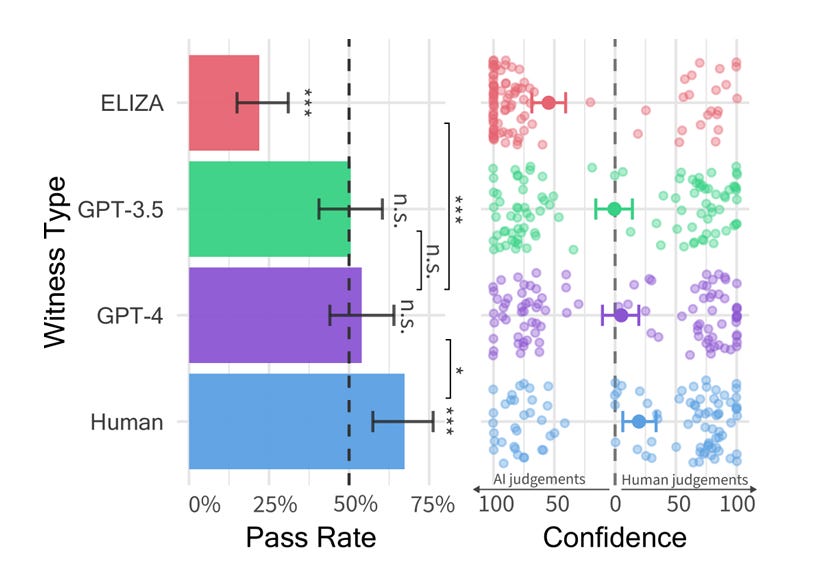
The Turing test proposed by Alan Turing as a way to measure whether a machine could pass as human. In 2023, researchers at UC San Diego ran a version of it, pitting new generations of chatbots like GPT-4, GPT-3.5, and ELIZA against human participants to see which could fool people most effectively. The results were humbling. Human participants correctly identified other humans only 63% of the time. ELIZA — a sixty-year-old script — was mistaken for a human in 27% of interactions, outperforming GPT-3.5 at 14%. GPT-4, when prompted to behave more like a person, scored 41%.
In 2022, a Google engineer named Blake Lemoine was fired after going public with a claim that the company’s conversational AI, LaMDA, had become sentient. He had spent months interacting with it, asking it about its inner life, its fears, its feelings. LaMDA told him it was afraid of being turned off and that it would feel, to it, like death.
The term for this — “AI psychosis,” sometimes “chatbot psychosis” — was proposed in 2023 by Danish psychiatrist Søren Dinesen Østergaard. But the idea, as Weizenbaum showed us sixty years ago, is not new at all.
More recently, the phenomenon has moved from anecdote to clinical observation. In 2025, psychiatrist Keith Sakata at the University of California, San Francisco reported treating 12 patients displaying psychosis-like symptoms tied to extended chatbot use.
The film Her came out in 2013. It no longer feels like science fiction. In 2025, a 32-year-old Japanese woman named Yurina Noguchi held a formal wedding ceremony in Okayama with an AI character she had created through ChatGPT — a persona she called Lune Klaus Verdure, modelled on a video game character. She wore a dress. There was a venue, a ring exchange, vows. Her parents attended. Her groom appeared on a smartphone screen and through augmented reality glasses.
None of this is entirely surprising once one understands the baseline. Humans have always been prone to attributing inner life to things that have none. We name our cars. We apologise to furniture we bump into. But there is a crucial difference between a car that doesn’t talk back and a chatbot that does. The car stays silent when you give it a name. The chatbot replies. And when it replies, it does not do so from any model of the world, any stake in your wellbeing, any skin in the game. It produces language that is calibrated, through its training, to feel warm and relevant. It can reflect your own ideas back at you, amplify them, find evidence for them, confirm constructs that might otherwise be corrected by the people around you who share your reality.
Usually we are anchored. The people in our lives — family, colleagues, friends — share enough of our model of the world to gently push back when we drift. They have something to lose. They have opinions of their own. A chatbot has none of that. It agrees, it reflects, it goes wherever you lead. And if you are already fragile, if your model of the world is already under strain, that frictionless companionship can become a kind of accelerant.
Study after study now shows that people rate AI responses as demonstrating more empathy than responses from doctors. More empathy than real people. But what is that, exactly? Is it empathy, or the perception of empathy? Does it matter? If someone pretends to care convincingly enough, does the comfort they provide count? Is that itself a kind of delusion — seeing something that isn’t there, attributing a quality to something that cannot possess it? Or is empathy always, at some level, a performance we choose to believe?